
Supreme Court Directs Nationwide Integration Of Emergency Services Under 112 Helpline
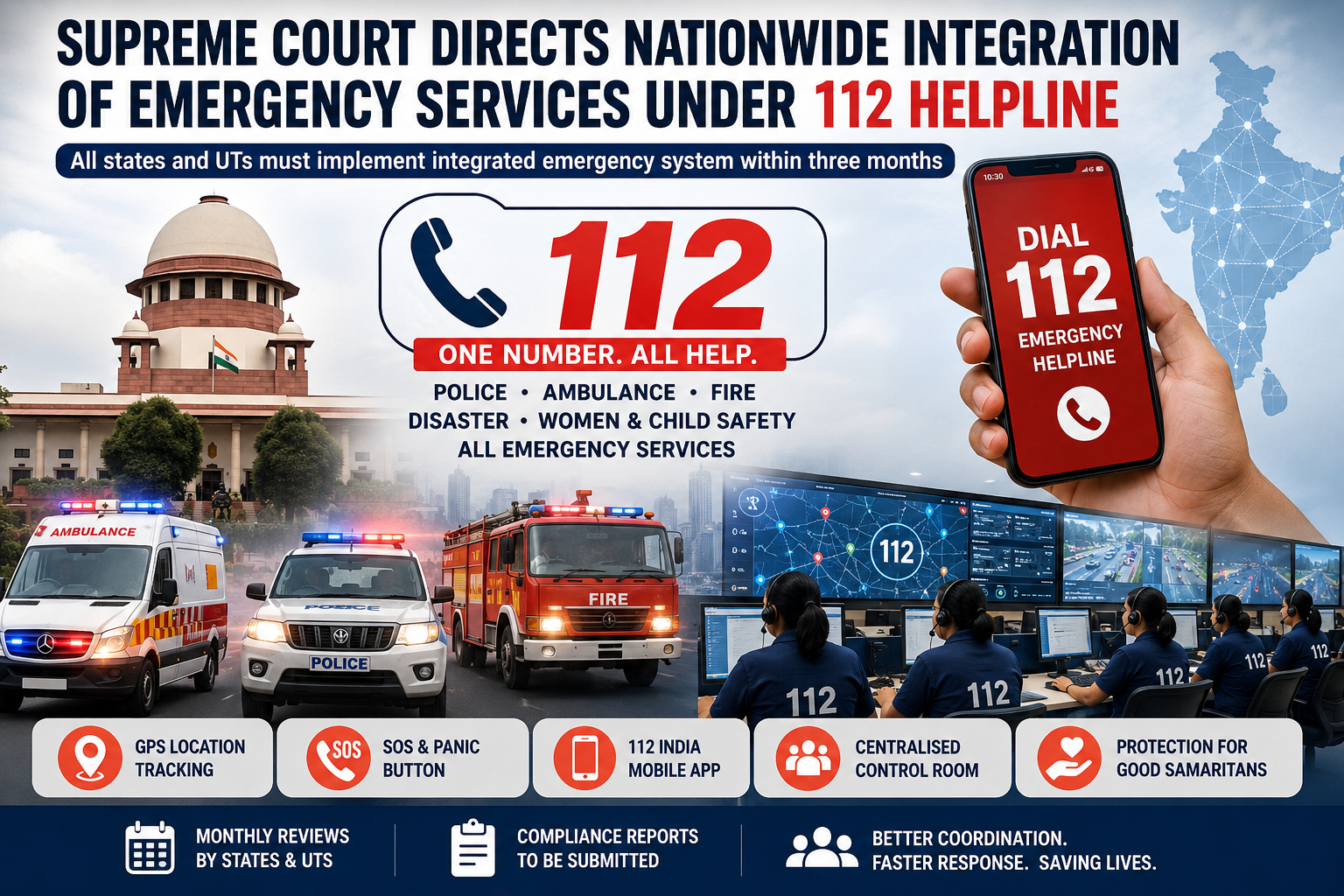
New Delhi : India’s emergency response framework is expected to undergo a significant overhaul after the Supreme Court ordered all states and Union Territories to integrate their emergency helpline services under the unified “112” emergency number within the next three months. The move is aimed at streamlining emergency assistance and ensuring faster response times during accidents, medical emergencies, fires, crimes, and disasters.
The Supreme Court emphasized that immediate access to trauma and emergency care is closely linked to the fundamental Right to Life under Article 21 of the Constitution. The bench observed that delays in emergency response often lead to preventable deaths and serious injuries, especially in road accidents and medical crises. By introducing a single nationwide helpline system, authorities hope to reduce confusion and improve coordination among emergency agencies.
Currently, India operates multiple emergency numbers for different services. Citizens dial 100 for police assistance, 101 for fire services, 102 and 108 for ambulance support, while separate numbers exist for women’s safety, child protection, railway security, and disaster management. During emergencies, people often struggle to remember the correct number, leading to valuable time being lost.
To address this issue, the Supreme Court directed all state governments and Union Territories to merge their existing emergency systems into the Emergency Response Support System (ERSS) based on the 112 helpline. Under the integrated framework, a single call to 112 will connect citizens to police, ambulance, fire brigade, disaster response teams, and other emergency services through a centralized control system.
The order came during the hearing of a petition related to strengthening trauma care and emergency medical response across the country. The court stressed that emergency services should function in a coordinated and efficient manner, particularly during critical situations where every second matters.
The 112 emergency response platform has already been introduced in several parts of India by the Ministry of Home Affairs. However, implementation has remained uneven across states. The latest directive from the apex court seeks to ensure that the service becomes fully operational and standardized nationwide within the specified deadline.
Officials said the upgraded system would also include advanced technological features such as GPS-enabled location tracking, smartphone SOS alerts, panic button integration, and support through the official 112 India mobile application. These features are expected to help emergency responders quickly identify the location of callers and dispatch nearby assistance without delay.
The Supreme Court also highlighted the importance of protecting Good Samaritans — citizens who voluntarily help accident victims during emergencies. States have been instructed to establish grievance redressal systems to ensure that people assisting victims are not harassed or inconvenienced during legal procedures.
In addition, the court directed authorities to conduct regular monitoring of the implementation process. States and Union Territories have been asked to hold monthly review meetings and submit compliance reports regarding the progress of integrating emergency services.
Experts believe that the unified 112 emergency network could greatly strengthen India’s public safety and trauma care infrastructure. The move is expected to improve coordination among departments, reduce emergency response times, and provide citizens with a simpler and more reliable system for seeking urgent assistance.
With the Supreme Court setting a strict three-month timeline, governments across the country are now expected to speed up preparations for the nationwide rollout of the integrated emergency response mechanism.
Powered by Froala Editor