
CBSE Rejects Tampering Allegations Amid Row Over Digital Evaluation System
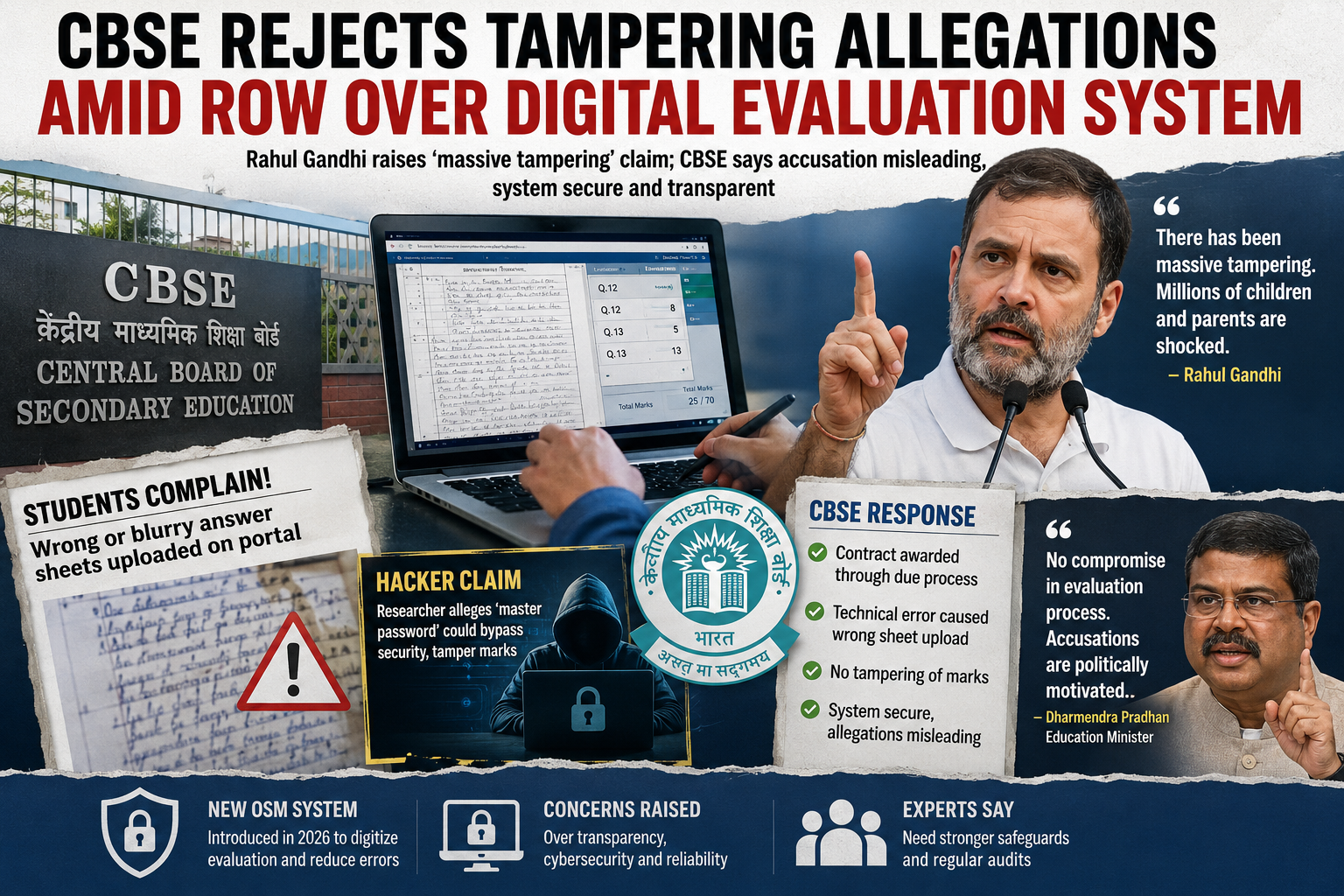
New Delhi : A major controversy has broken out over the Central Board of Secondary Education’s (CBSE) newly introduced digital evaluation system for Class 12 board examinations after allegations of large-scale tampering surfaced online. The dispute intensified after Congress leader Rahul Gandhi questioned the transparency of the board’s On-Screen Marking (OSM) system and raised concerns about possible irregularities in the evaluation process.
The OSM system was introduced this year to modernize the assessment of answer sheets by shifting from traditional manual checking to digital evaluation. Under the new method, answer scripts are scanned and uploaded online, allowing evaluators to check papers digitally. CBSE said the initiative was aimed at reducing human errors, speeding up the result process, and improving efficiency in board examinations.
However, the system soon came under scrutiny after several students claimed that the answer sheets uploaded on the portal were either blurred, incomplete, or did not belong to them. In one widely discussed case, a student from Delhi alleged that the Physics answer sheet displayed on the portal carried a different handwriting and content. The issue sparked panic among students and parents, many of whom feared that technical glitches could affect final scores and future academic opportunities.
Rahul Gandhi strongly criticized the board over the matter and accused authorities of failing to protect the integrity of the examination system. He alleged that there had been “massive tampering” in the evaluation process and demanded accountability from officials involved in implementing the digital system. Gandhi also questioned the decision to award the project contract to Hyderabad-based company Coempt Edu Teck, claiming that the firm had previously faced controversies under its former identity.
The Congress leader further argued that students and parents across the country had lost trust in the examination process due to the confusion surrounding the uploaded answer sheets. He called for a transparent investigation into the functioning of the digital evaluation platform and demanded that students affected by technical errors should not suffer academically.
In response, CBSE rejected all allegations of manipulation and maintained that the evaluation process remained secure and transparent. The board clarified that the contract for the OSM system had been awarded through a proper tendering process in accordance with government financial regulations. CBSE described the accusations as misleading and said the issue involving mismatched answer sheets was caused by a technical error during the uploading process, not by tampering of marks.
The controversy grew further after a young cybersecurity researcher claimed that a testing portal connected to the system had vulnerabilities, including the presence of a so-called “master password” capable of bypassing security verification. The researcher suggested that such flaws could potentially allow unauthorized access to the system. However, CBSE dismissed the claims, stating that the vulnerabilities were discovered only on a test platform containing dummy data and not on the live examination system.
Union Education Minister Dharmendra Pradhan also defended CBSE and accused opposition leaders of spreading misinformation for political reasons. He assured students and parents that there had been no compromise in the evaluation process and that the board remained committed to maintaining fairness and transparency.
The incident has nevertheless raised broader concerns about cybersecurity, data protection, and the challenges of implementing digital examination systems on a national scale. Education experts believe the controversy highlights the need for stronger safeguards and regular technical audits to ensure trust in future digital evaluation methods.
Powered by Froala Editor