
Supreme Court Declines Urgent Hearing on ‘Cockroach Janta Party’ Plea
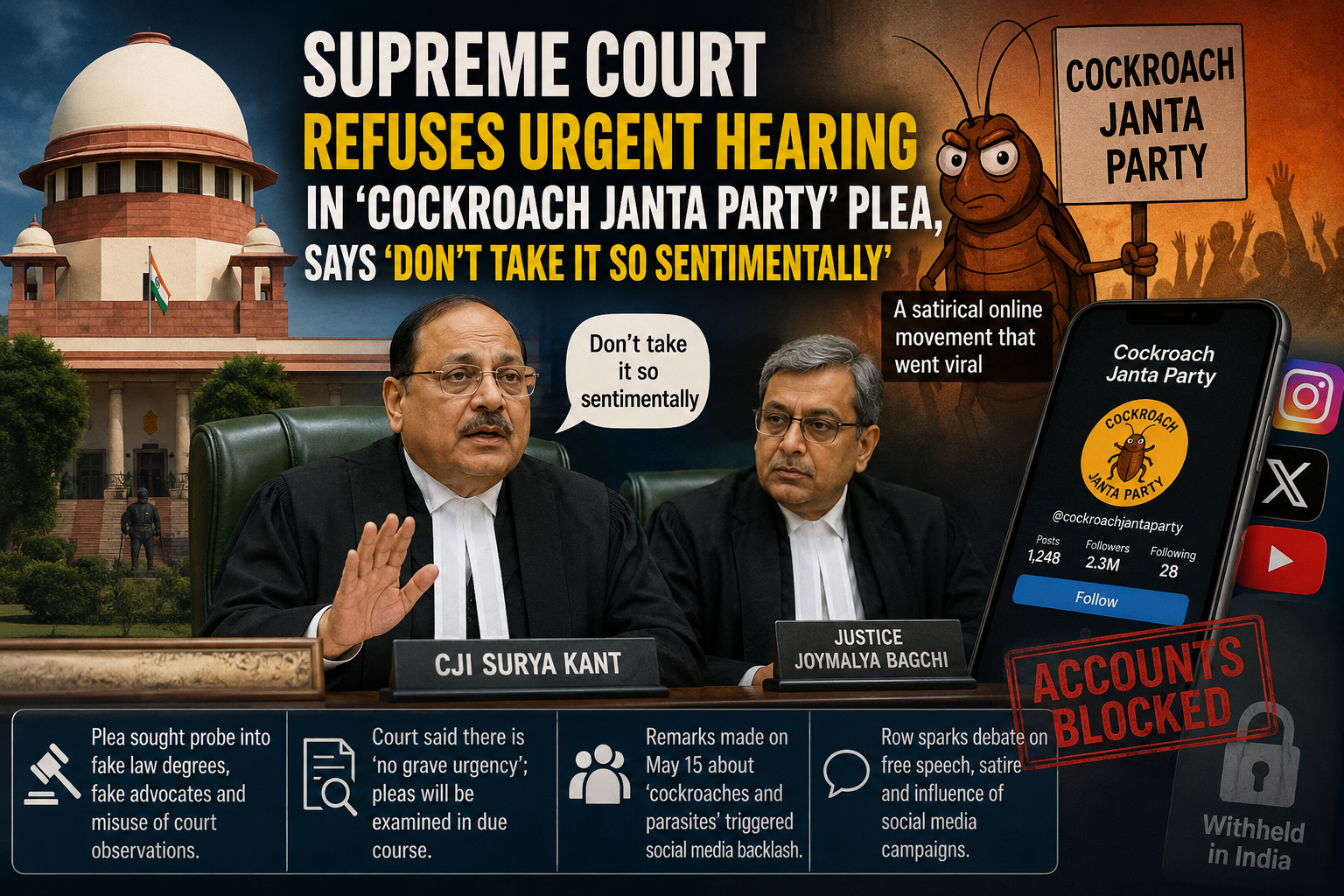
The Supreme Court on Monday declined to grant an urgent hearing on petitions connected to the viral “Cockroach Janta Party” controversy, observing that the matter did not require immediate intervention. During the proceedings, Chief Justice of India Surya Kant advised petitioners not to take the issue “so sentimentally,” while assuring that the pleas would be considered through the normal judicial process.
A bench headed by CJI Surya Kant and Justice Joymalya Bagchi was hearing submissions seeking urgent listing of petitions demanding action over alleged fake law degrees, misuse of court remarks on social media, and online campaigns linked to the satirical “Cockroach Janta Party” movement.
The petitioners argued that certain social media content had distorted comments made during an earlier hearing related to fake advocates and irregularities in the legal profession. They claimed the viral online campaign had led to widespread misinformation and demanded a probe into those allegedly responsible for spreading manipulated narratives.
The controversy began after remarks made during a May 15 Supreme Court hearing regarding fake law degrees and concerns over the legal profession. During the proceedings, the Chief Justice reportedly used terms such as “cockroaches” and “parasites” while criticizing individuals allegedly entering the profession through fraudulent means. The comments soon sparked intense reactions online, with many social media users interpreting the statements differently.
Following the backlash, the Chief Justice later clarified that the observations were directed only at people using fake credentials to enter the legal system and were not intended against unemployed youth or the general public.
Soon after, a satirical online campaign called the “Cockroach Janta Party” emerged across social media platforms. The movement gained rapid popularity through memes, political satire, and criticism related to unemployment and governance. Several accounts associated with the campaign reportedly attracted large followings within days.
Reports also indicated that some social media accounts linked to the movement were withheld or restricted in India, prompting legal challenges in the Delhi High Court. Activists and supporters of the campaign argued that satire and criticism were part of democratic free speech, while others raised concerns about misinformation and the misuse of judicial remarks.
During Monday’s hearing, the Supreme Court stated that there was no extraordinary urgency requiring immediate listing of the petitions. The bench maintained that the issues raised would be examined in accordance with legal procedure.
The controversy has now expanded beyond the courtroom, evolving into a broader public debate over freedom of expression, the role of satire in politics, and the impact of viral social media campaigns on public institutions.
Powered by Froala Editor