

Household Savings Fall to 45-Year Low, RBI Raises Concern Over Rising Debt
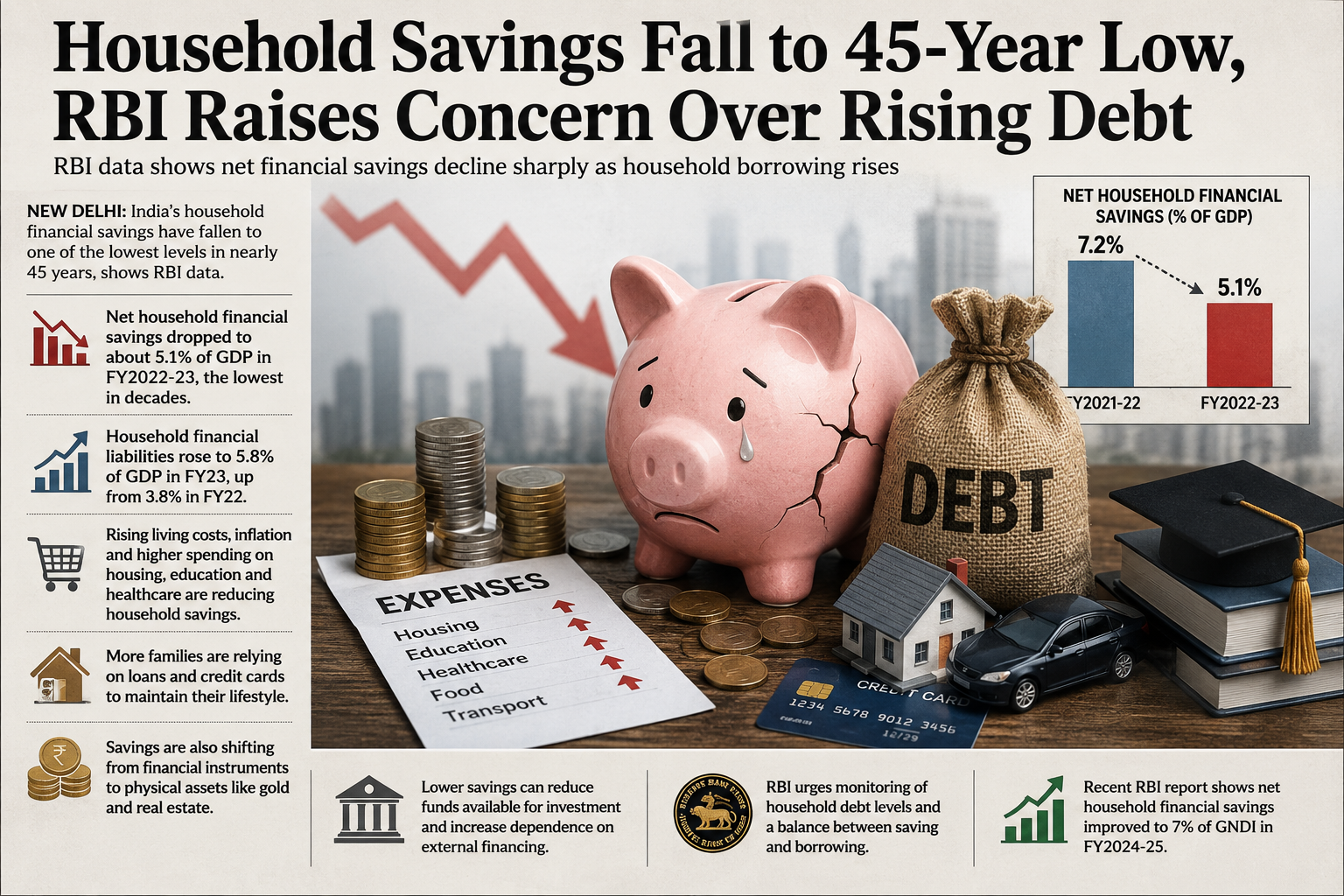
New Delhi, June 7: India's household financial savings have dropped to their lowest level in nearly 45 years, according to data released by the Reserve Bank of India (RBI). The sharp decline has sparked concerns among economists and policymakers, who warn that increasing household debt and declining savings could pose challenges for long-term economic stability.
The RBI's findings reveal that net household financial savings fell significantly during the financial year 2022-23, reaching one of the lowest levels recorded in decades. At the same time, household liabilities witnessed a steep rise, indicating that more families are depending on loans and credit facilities to meet their expenses and maintain their standard of living.
Experts attribute the decline in savings to a combination of factors, including persistent inflation, rising living costs, and increased spending on housing, education, healthcare, and consumer goods. As household expenses grew, many families found it difficult to set aside money for savings, leading to a reduction in overall financial reserves.
The central bank's data also highlights a substantial increase in household borrowing. Personal loans, vehicle loans, housing loans, and credit card usage have all witnessed strong growth in recent years. While borrowing can support economic activity and consumption, economists caution that excessive dependence on debt could create financial stress if incomes fail to keep pace with repayment obligations.
Analysts believe that a portion of household wealth has also shifted from traditional financial savings instruments, such as bank deposits and small savings schemes, toward physical assets like gold and real estate. Such investments are often considered safer during periods of economic uncertainty and inflation, but they do not contribute directly to the country's pool of financial savings.
The decline in household savings carries broader implications for the Indian economy. Household savings serve as a major source of domestic investment capital, helping fund infrastructure projects, industrial expansion, and economic development. A sustained reduction in savings could limit the availability of funds for investment and increase dependence on external sources of financing.
The RBI has emphasized the importance of maintaining a healthy balance between savings and borrowing. Although India's household debt levels remain lower than those seen in many developed and emerging economies, the pace of debt accumulation has attracted attention from policymakers. The central bank has urged continued monitoring of retail lending trends to ensure financial stability.
Despite the concerning figures, recent indicators suggest signs of improvement. According to the RBI's latest assessments, household financial savings have shown a gradual recovery, supported by easing inflation, stronger income growth, and a moderation in household liabilities. This recovery is expected to strengthen household balance sheets and improve financial resilience.
Economists argue that sustained income growth, employment generation, and stable prices will be essential for rebuilding savings levels in the coming years. They stress that long-term economic growth is more sustainable when driven by rising incomes and healthy savings rather than excessive borrowing.
As India continues its journey toward becoming a major global economy, strengthening household finances remains a key priority. The latest RBI data serves as a reminder that financial security at the household level is crucial for ensuring broader economic stability and future prosperity.
Powered by Froala Editor