

India’s Birth Rate Falls Below Replacement Level, Marking Historic Demographic Transition
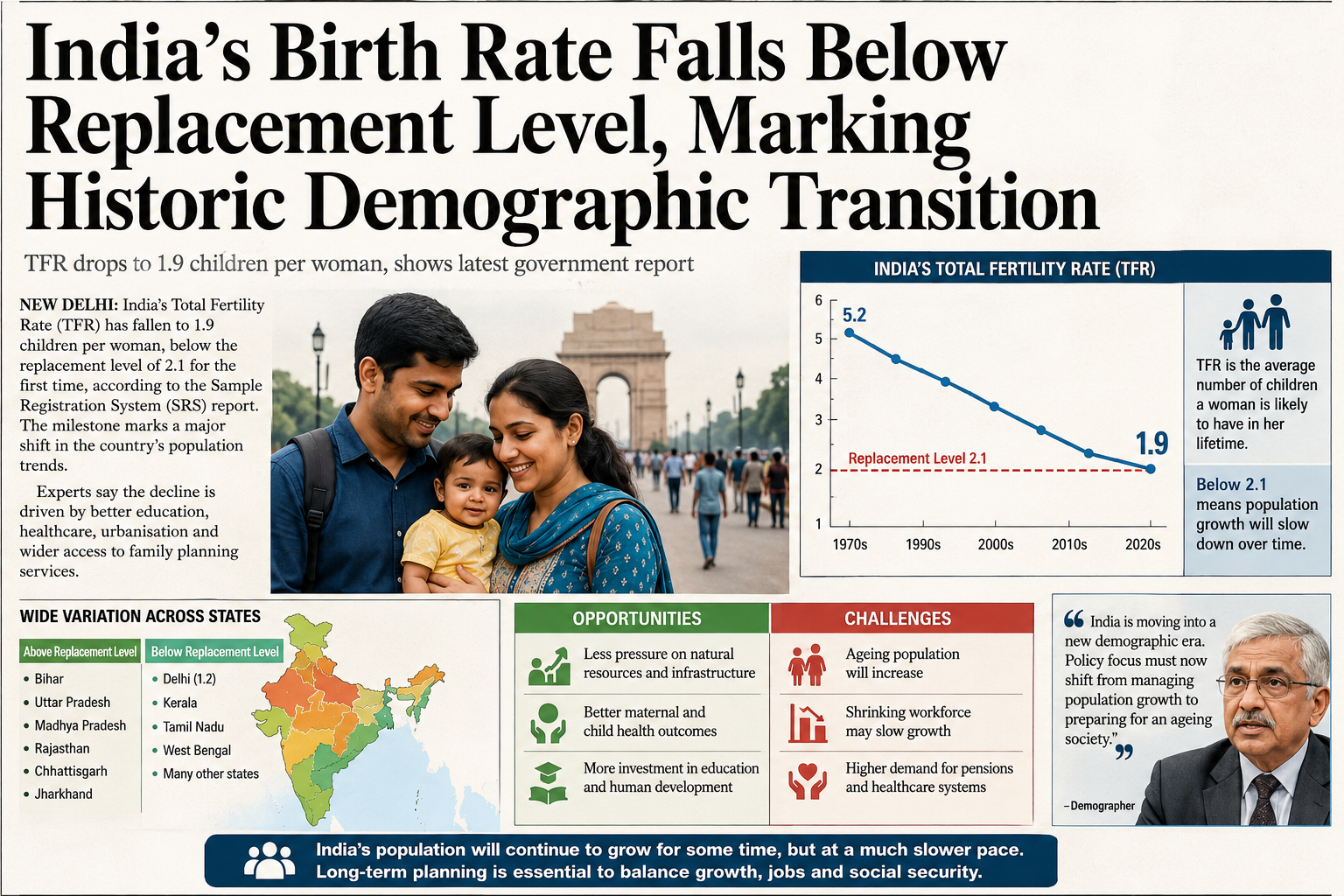
New Delhi: India has entered a significant demographic phase after the latest government data revealed that the country’s fertility rate has dropped below the replacement level for the first time. According to the Sample Registration System (SRS) report, India’s Total Fertility Rate (TFR) now stands at 1.9 children per woman, lower than the replacement benchmark of 2.1.
The development represents a major shift in the country’s population trends and highlights the success of decades of efforts in improving healthcare, education, women’s empowerment, and access to family planning services. Demographers describe the change as a landmark moment that could reshape India’s social and economic landscape in the coming decades.
The replacement level fertility rate refers to the average number of children required per woman to maintain a stable population from one generation to the next, excluding migration. A fertility rate below this level generally leads to slower population growth and, over time, may result in population decline if the trend continues.
India’s fertility rate has witnessed a steady decline over the past five decades. In the early 1970s, women in India gave birth to an average of more than five children. Since then, rapid urbanisation, increased literacy, rising living standards, and better access to reproductive healthcare have contributed to smaller family sizes across the country.
However, fertility trends vary widely among states. Several northern and central states, including Bihar, Uttar Pradesh, Madhya Pradesh, Rajasthan, Chhattisgarh, and Jharkhand, continue to record fertility rates above the replacement level. In contrast, many southern and urbanised regions have seen much sharper declines. Delhi currently reports the lowest fertility rate in the country, while states such as Kerala and Tamil Nadu also have significantly lower birth rates.
Experts note that falling fertility rates bring both opportunities and challenges. A slower-growing population can ease pressure on resources such as housing, water, healthcare, and education. Smaller family sizes may also allow households to invest more in the health and education of children, contributing to overall human development.
At the same time, economists and policymakers warn that persistently low fertility rates could create long-term challenges. As birth rates decline and life expectancy rises, the proportion of elderly citizens in the population is expected to increase. This could lead to a shrinking workforce, higher dependency ratios, and greater demand for pension and healthcare systems.
The issue has attracted global attention as many countries, including China, Japan, South Korea, and several European nations, are already grappling with the consequences of ageing populations and declining birth rates. The discussion gained further visibility after entrepreneur Elon Musk commented on reports about India’s fertility decline, linking it to broader global demographic concerns.
Despite the drop below replacement level, experts emphasize that India’s population is unlikely to decline immediately due to its large young population base. Population momentum is expected to keep overall numbers growing for some time. Nevertheless, the latest figures signal that India is moving into a new demographic era, one that will require careful planning to balance economic growth, workforce needs, and the welfare of an ageing population.
Powered by Froala Editor