

Centre Amends Motor Vehicle Rules to Allow E100 Fuel in Flex-Fuel Vehicles
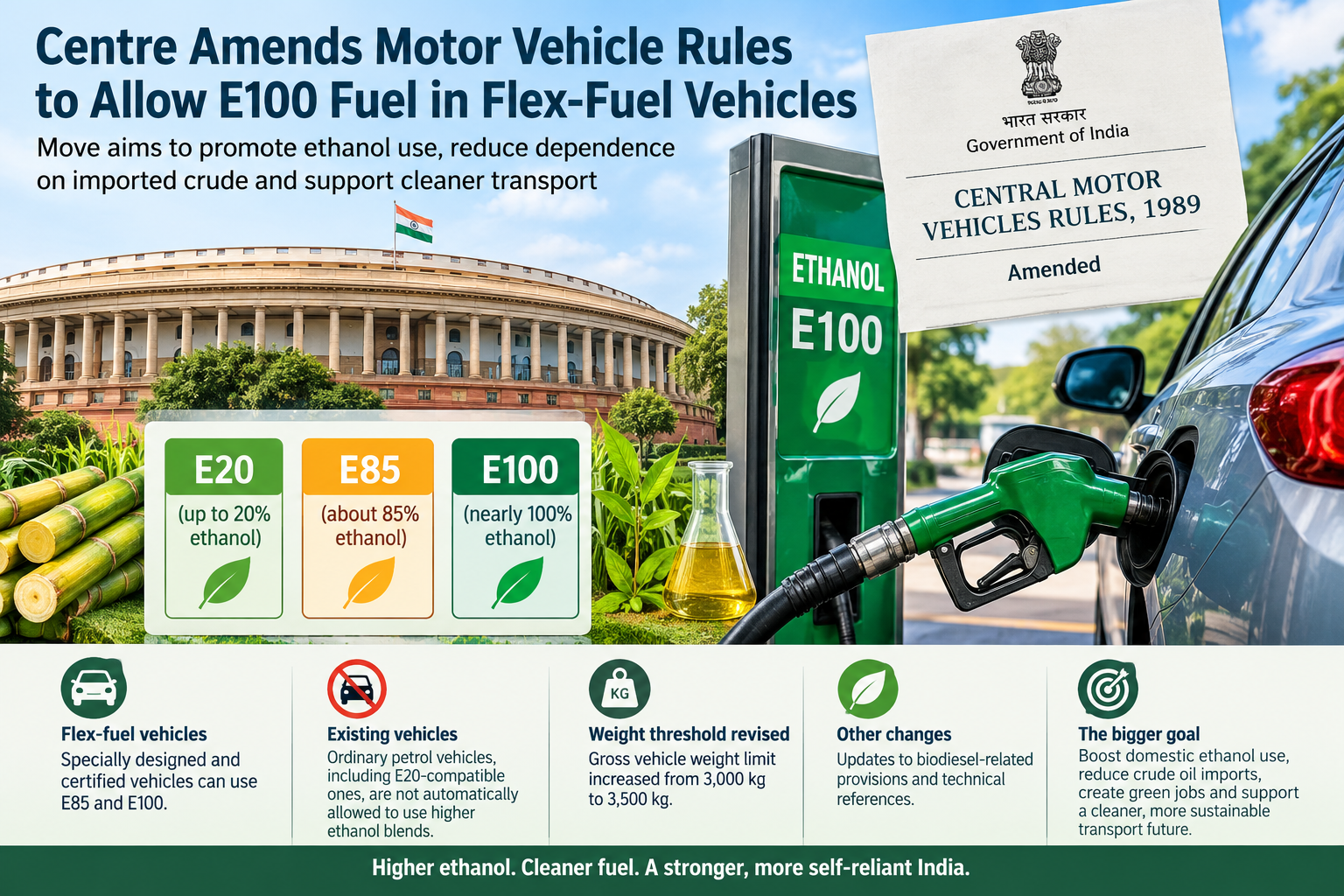
New Delhi, October 26: The Central Government has amended the Central Motor Vehicles Rules, 1989, to facilitate the use of high-ethanol fuels, including E85 and E100, in specially designed flex-fuel vehicles. The amendment, notified by the Ministry of Road Transport and Highways, aims to promote ethanol-based fuels and reduce India's dependence on imported crude oil.
Under the revised provisions, compatible flex-fuel vehicles can be designed and certified to operate on fuels containing higher proportions of ethanol. E85 contains approximately 85 per cent ethanol, while E100 refers to fuel consisting almost entirely of ethanol. The move is expected to support the development and adoption of alternative-fuel technologies in India's automobile sector.
The amendment forms part of the government's broader efforts to increase the use of domestically produced ethanol, strengthen energy security and encourage cleaner transport options. Greater ethanol consumption could also create additional demand for agricultural feedstocks used in ethanol production.
The revised rules include changes to technical provisions governing vehicle certification and emission-related requirements. The notification also revises a specified gross vehicle weight threshold from 3,000 kg to 3,500 kg and updates certain provisions relating to biodiesel and associated technical references.
However, the changes do not mean that all existing petrol vehicles can run on E85 or E100. Vehicles must be specifically engineered and approved for the relevant fuel blend. Owners of conventional petrol vehicles, including those compatible with E20 petrol, should continue using fuels permitted by their manufacturers.
E20 petrol, which contains up to 20 per cent ethanol, has been a key component of India's ethanol-blending programme. The introduction of provisions for higher-ethanol fuels represents a further step towards diversifying the country's transport energy options.
Industry observers expect the regulatory changes to provide a clearer framework for automakers developing flex-fuel vehicles. However, wider adoption will depend on vehicle availability, fuel-distribution infrastructure, affordability and consumer awareness.
The amendment is also expected to encourage investment in alternative-fuel technologies as India seeks to reduce its exposure to global crude oil price fluctuations.
The government has been promoting ethanol blending as part of its strategy to improve energy security and support domestic production. The latest changes provide a regulatory pathway for vehicles designed to use substantially higher ethanol concentrations, while maintaining the requirement that vehicles meet applicable safety and emission standards.
The key takeaway is that the revised rules facilitate E85 and E100-compatible flex-fuel vehicles; they do not make higher-ethanol fuels suitable for every existing petrol vehicle.
Powered by Froala Editor