
UPI Payments Up to ₹2,000 to Remain Free; New MDR Rules for Higher-Value Merchant Transactions
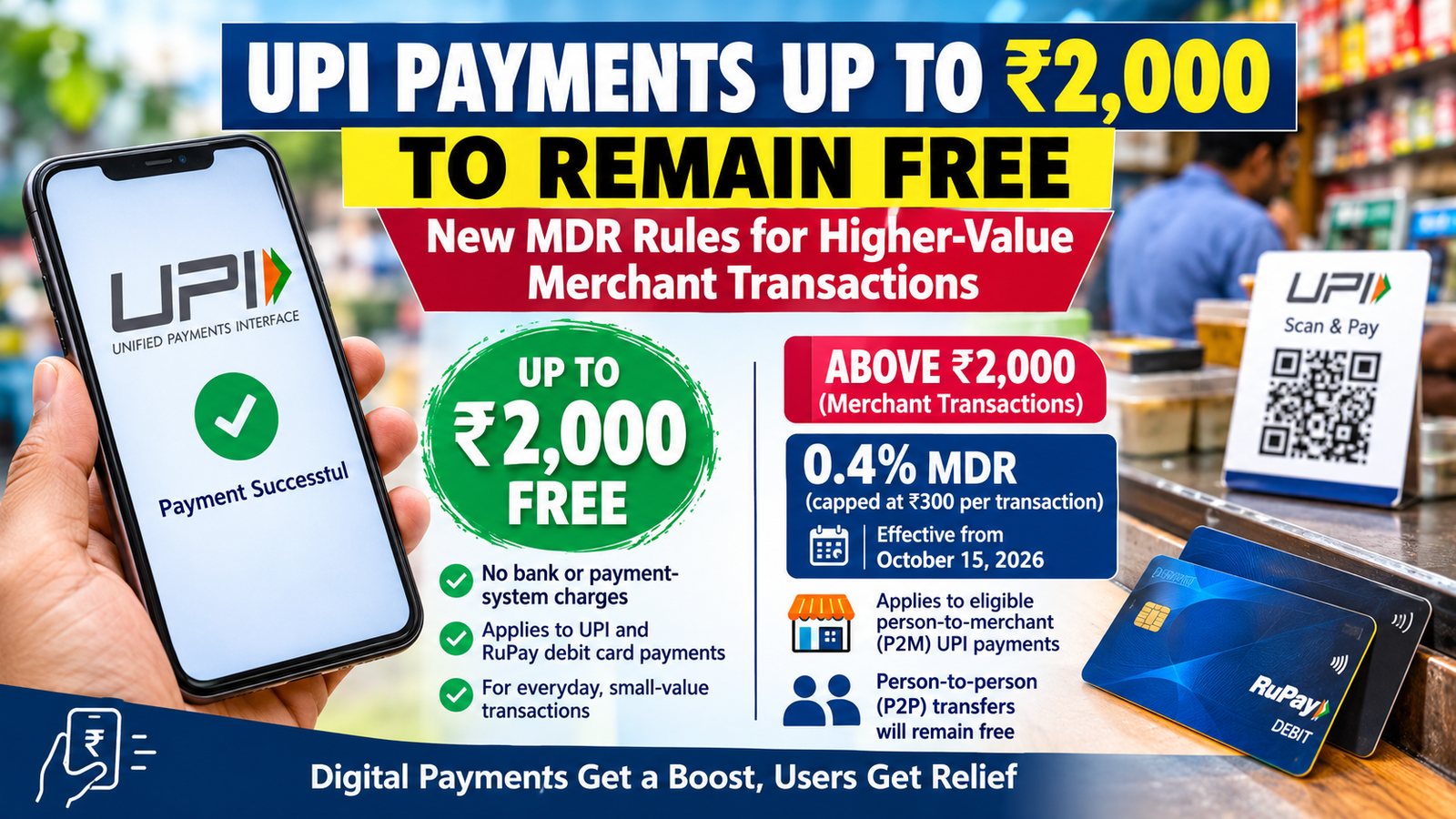
New Delhi: Digital payments through the Unified Payments Interface (UPI) will continue to remain free for transactions of up to ₹2,000, according to a recent government clarification aimed at providing greater certainty to users and the digital payments ecosystem.
The clarification comes amid discussions over the possibility of charges being introduced on UPI transactions following amendments to the Payment and Settlement Systems framework. The government has made it clear that banks and payment-system providers cannot impose direct or indirect charges on eligible UPI transactions of up to ₹2,000. Similar protection has also been extended to payments made through RuPay debit cards.
The decision is expected to provide relief to millions of consumers who regularly use UPI for everyday payments such as groceries, food, transportation, utility bills and other small-value purchases. UPI has become one of the most widely used digital payment systems in India, allowing users to transfer money instantly through mobile phones and banking applications.
However, the government’s clarification comes alongside a new framework concerning merchant transactions above the ₹2,000 threshold. The National Payments Corporation of India (NPCI) has announced a new Merchant Discount Rate (MDR) structure for eligible person-to-merchant (P2M) UPI payments exceeding ₹2,000.
Under the proposed framework, an MDR of 0.4 per cent will apply to eligible merchant UPI transactions above ₹2,000 from October 15, 2026. The charge will reportedly be subject to a maximum cap of ₹300 per transaction. The MDR is generally a fee associated with processing merchant payments and is different from a direct charge imposed on consumers.
Importantly, person-to-person (P2P) UPI transactions will continue to remain free. This means individuals transferring money to family members, friends or other individuals will not be required to pay the newly introduced merchant-related charge.
The new arrangement is particularly significant because high-value UPI transactions account for a substantial share of the overall value processed through the platform. While transactions above ₹2,000 represent a relatively small portion of the total number of P2M UPI payments, they contribute considerably to the overall transaction value.
The government’s decision to retain zero charges on smaller UPI payments is also being viewed as an effort to protect the affordability and accessibility of digital payments. Small-value transactions form an important part of India’s cashless-payment ecosystem, particularly among consumers and small businesses.
The latest rules are therefore expected to create a distinction between everyday low-value UPI payments and higher-value merchant transactions. Users making payments of up to ₹2,000 can continue using UPI without worrying about additional bank or payment-system charges, while businesses processing eligible transactions above the threshold will have to factor the MDR framework into their payment operations.
With UPI continuing to expand across India, the latest clarification is likely to influence how consumers, merchants, banks and payment companies approach digital transactions in the coming months.
Powered by Froala Editor