

Odisha Empanels Seven Leading Institutes to Audit Welfare Schemes
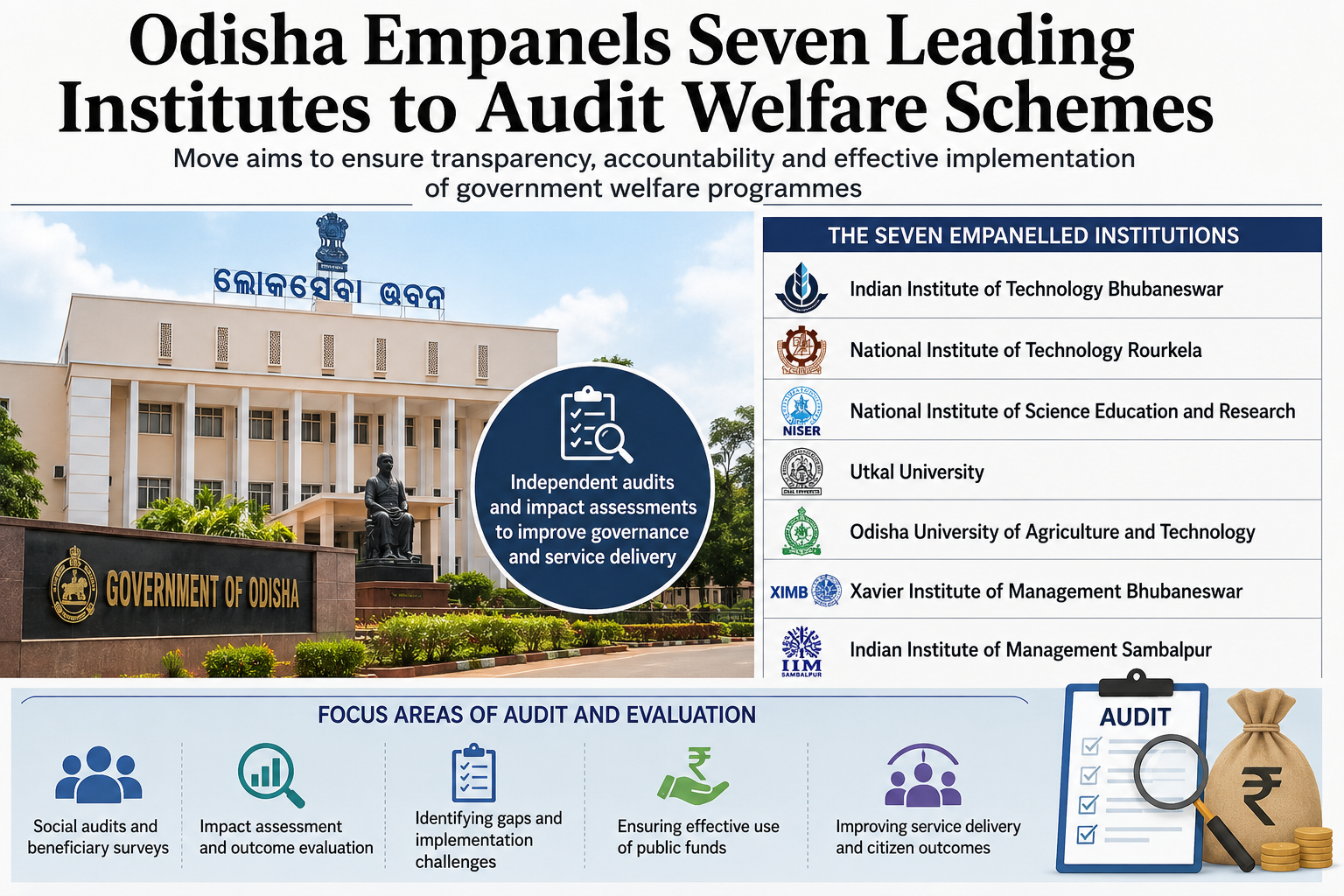
Bhubaneswar, June 7: In a significant move aimed at improving transparency, accountability, and efficiency in public welfare delivery, the Odisha government has empanelled seven reputed academic and research institutions to conduct independent audits and impact assessments of various welfare schemes operating across the state.
The initiative is expected to strengthen monitoring mechanisms and provide the government with reliable feedback on the implementation and effectiveness of its flagship programmes. Officials said the decision reflects the state's commitment to evidence-based governance and ensuring that welfare benefits reach the intended beneficiaries.
The seven institutions selected for the empanelment include the Indian Institute of Technology (IIT) Bhubaneswar, National Institute of Technology (NIT) Rourkela, National Institute of Science Education and Research (NISER), Utkal University, Odisha University of Agriculture and Technology (OUAT), Xavier Institute of Management Bhubaneswar (XIMB), and the Indian Institute of Management (IIM) Sambalpur.
These institutions have been chosen based on their expertise in research, policy evaluation, data analysis, and field studies. They will undertake a range of activities, including social audits, beneficiary surveys, outcome evaluations, and impact assessments of welfare schemes implemented by various government departments.
According to government sources, the audits will cover schemes related to health, education, agriculture, women and child development, rural development, social security, and other key sectors. The findings are expected to help policymakers identify implementation gaps, assess programme outcomes, and recommend improvements where necessary.
Officials noted that independent evaluations conducted by reputed institutions would enhance the credibility of the audit process. The reports generated through these assessments will provide valuable insights into whether welfare initiatives are achieving their intended objectives and how public resources can be utilized more effectively.
The state government has increasingly emphasized data-driven decision-making in recent years. By involving external institutions with strong academic and analytical capabilities, authorities hope to gain an objective understanding of ground-level realities and the actual impact of welfare interventions on citizens.
Experts believe the initiative could help improve governance standards by introducing greater accountability into the welfare delivery system. Regular audits and impact studies can also support better planning and resource allocation while ensuring that schemes remain responsive to the evolving needs of beneficiaries.
The empanelled institutions are expected to work closely with concerned government departments and local authorities during the evaluation process. Their recommendations may play a key role in redesigning existing schemes, improving service delivery mechanisms, and shaping future welfare policies.
With this step, Odisha joins a growing number of states that are relying on academic expertise and independent assessments to strengthen public administration. The move underscores the government's focus on transparent governance and its determination to maximize the effectiveness of welfare spending for the benefit of citizens across the state.
The initiative is expected to create a robust framework for continuous monitoring and evaluation, ultimately contributing to better governance and improved outcomes for millions of beneficiaries in Odisha.
Powered by Froala Editor