
Seven Line Departments and KVK Join 3rd DLCC Meeting in Puri to Review Kharif Learnings and Plan Climate-Resilient Rabi Convergence
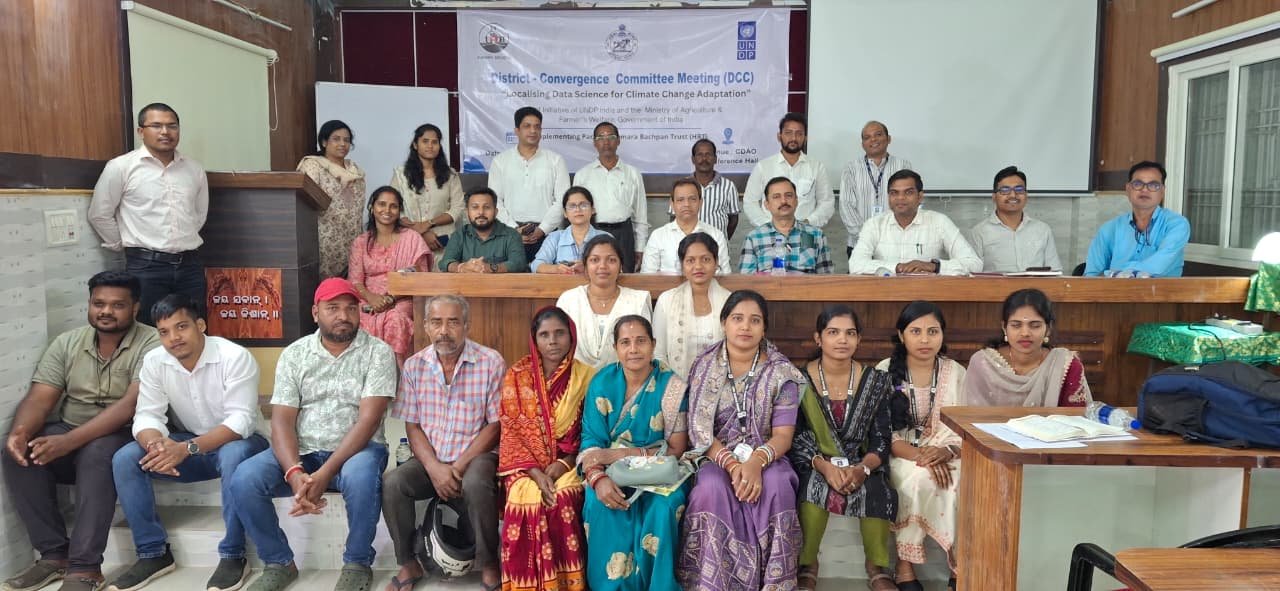
Puri : The 3rd District Level Convergence Committee (DLCC) Meeting under the Localizing Data Science for Climate Change Adaptation (LDSCCA) project was held at the CDAO Conference Hall, Puri, under the chairmanship of Shri Sibasish Mishra, Chief District Agriculture Officer (CDAO), Puri.
The quarterly convergence meeting was organized as a follow-up to the 2nd DLCC meeting held in May 2026 to review programme progress, assess the status of convergence commitments made by line departments, and jointly plan the action roadmap for the next quarter (December 2026–February 2027). Representatives from the District Agriculture Department, District Horticulture Department, Soil Conservation Department, District Fishery Office, Divisional Forest Office, District Animal Resources Development Office, Irrigation Department and senior scientists from Krishi Vigyan Kendra (KVK), Puri participated in the meeting along with the project team of the implementing partner.
The programme progress for June to October 2026 (Kharif 2026) was presented during the meeting. During the season, 71 farmers adopted climate-resilient paddy practices on 48 acres, including line transplanting by 30 farmers across 17 villages, SRI self-adopted by 12 farmers following last year’s demonstrations, mechanized line transplanting by 10 farmers in Bagalei village under PPP mode with the Agriculture Department, biofortified DRR-48 paddy by 19 farmers, and a PNR-15048 seed village with buy-back support from OSSC. A total of 285 Soil Health Cards were received by farmers, 50 kitchen gardens were set up, and 4 women farmers took up turmeric cultivation with planting material from the Horticulture Department. Twenty women are running a mushroom enterprise, with regular growers earning about ₹15,000 a month, while two women’s SHGs accessed ₹19 lakh in bank credit and five households in Kantijhadi installed rooftop solar under PM Surya Ghar. Convergence worth ₹15.16 lakh was leveraged from nine departments and agencies after the 2nd DLCC, and 12 of the 28 commitments made at that meeting have been achieved, with another 8 awaiting sanction or approval. Over two years, the project has reached all 2,241 households of Banakhandi and Simili Gram Panchayats and leveraged about ₹1.5 crore through 13 schemes of 9 line departments.
A key discussion centred on the season’s learning from Direct Seeded Rice (DSR). Anticipating a monsoon deficit of about 48%, 30 farmers, including 15 women, sowed DSR on 30 acres by the end of June; heavy rain between 30 June and 20 July submerged the young seedlings and about half the seed rotted. With guidance from the Agriculture Department, farmers switched to nursery-raised, flood-tolerant Swarna Sub-1 and local varieties. The experience highlighted the need for hyper-local 10–15 day rainfall and soil-moisture advisories, a contingency stock of drought- and flood-tolerant seed, and trigger-based switching between DSR and transplanting, reinforcing the project’s focus on turning climate data into timely, actionable advice for farmers. Delays in releasing scheme targets and funds to the block level, and the difficulty smallholders face with back-ended subsidies, were also discussed as key convergence challenges.
During the deliberations, the department-wise convergence action plan for December 2026–February 2027 (Rabi 2026–27) was discussed and finalized during the open house session. Key proposals include scaling up mechanized line transplanting to 30 farmers on 20 acres; pulses on 105 acres, with green gram for 180 farmers and black gram for 40 farmers; mustard and sunflower for 19 farmers on 8 acres; vegetable seed, marigold and mushroom support from the Horticulture Department; Matsya Pokhari Yojana, bio-floc and women’s SHG fish farming from the Fisheries Department; goatery, azolla, poultry, duckery and backyard poultry units from the Veterinary Department; 100 vermicompost units through OLM; field training support from the Soil Conservation Department; minor irrigation canal repair by the Irrigation Division; and technical training and machinery support from KVK Puri.
Powered by Froala Editor